
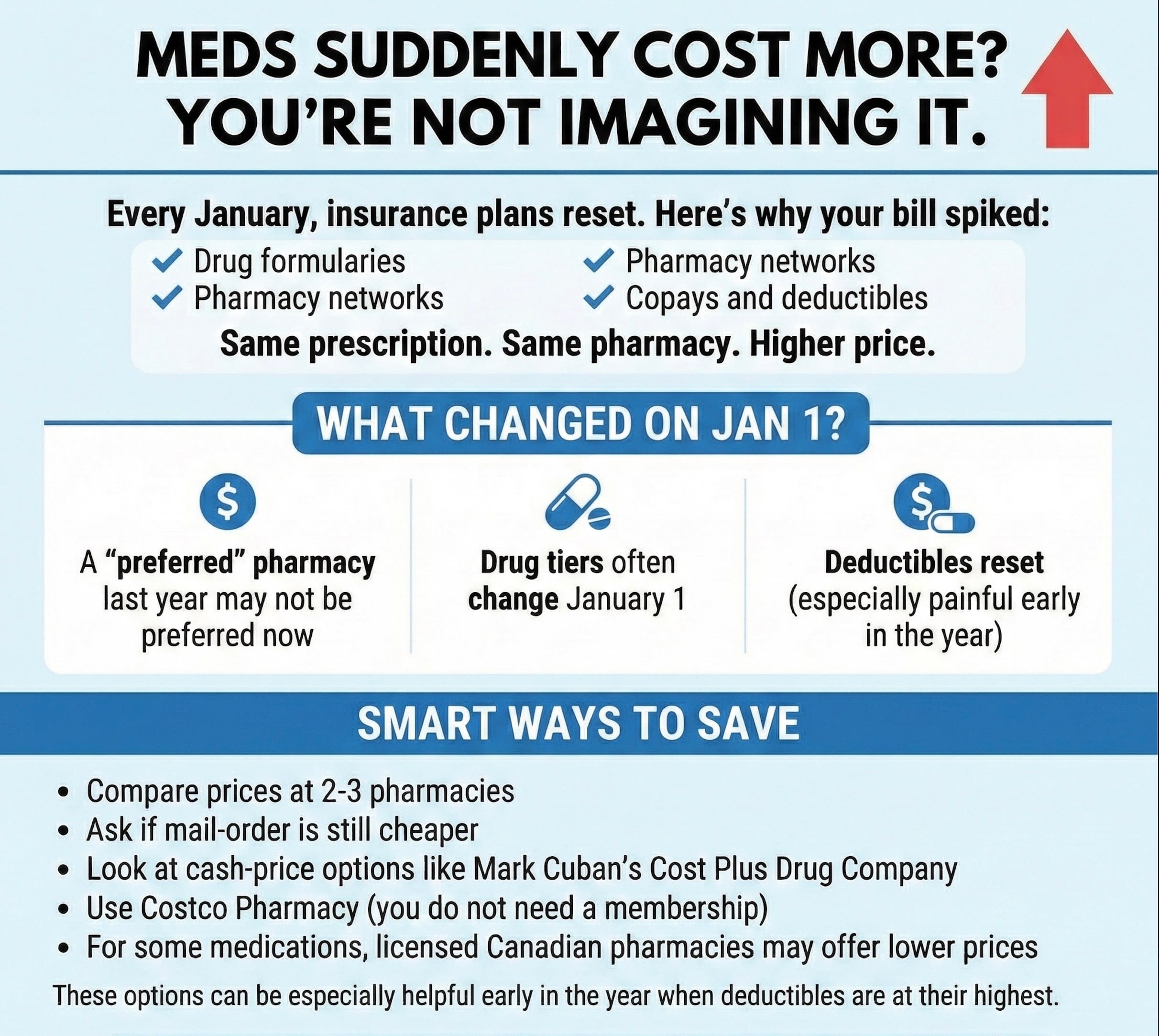
Every January, many Medicare beneficiaries and individuals on employer or marketplace health plans are surprised to see that their prescription drug prices have changed — sometimes a little, sometimes a lot.
Even if your medications stayed the same, the pharmacy you use may no longer offer the lowest price in the new plan year.
Understanding why this happens — and what to do about it — can help you save money, avoid frustration, and keep your medications predictable throughout the year.
⸻
Why Drug Prices Change on January 1st
A new plan year means insurance companies refresh their:
• Formularies (the list of covered medications)
• Preferred pharmacy networks
• Tier structures
• Copays and coinsurance amounts
• Deductible rules
All of these can affect what you pay at the pharmacy counter, even for the exact same medication.
Here’s what may change without you realizing it:
• A medication that was a Tier 2 drug last year might become Tier 3.
• A pharmacy that was “preferred” last year may now be “standard” — meaning higher copays.
• New agreements between your plan and pharmacies can shift pricing dramatically.
• Your plan may now offer deeper discounts at certain retail or mail-order pharmacies.
⸻
Preferred vs. Standard Pharmacies: Why It Matters
Many people don’t realize that the same prescription can cost very different amounts depending on where it’s filled.
For example:
• A 30-day supply at a preferred pharmacy might cost $0–$5.
• The same prescription at a standard pharmacy might cost $15–$25 (or more).
Some plans even have exclusive agreements where certain medications cost dramatically less at one chain compared to another.
It’s not uncommon for clients to save hundreds of dollars per year just by switching where they pick up their prescriptions.
⸻
Mail-Order Pharmacies: Still a Good Deal?
Mail-order pharmacies can be a money saver — but not always.
Things to watch for this year:
• Some plans now price mail-order prescriptions exactly the same as retail.
• Others offer deeper discounts for 90-day supplies.
• Occasionally, mail-order becomes more expensive if it is no longer “preferred.”
If you used mail-order last year, it’s worth checking your updated pricing before refilling your next 90-day prescription.
⸻
Additional Ways to Lower Prescription Costs
If your insurance pricing still feels high, there are legitimate alternatives many people overlook:
• Mark Cuban Cost Plus Drug Company
This online pharmacy offers many generic medications at transparent, low cash prices — often cheaper than insurance copays. No insurance is required, and pricing is publicly listed so you can compare before you fill.
• Costco Pharmacy (No Membership Required)
You do not need a Costco membership to use their pharmacy. Costco often negotiates very competitive cash prices on common medications, and for some prescriptions it can be cheaper than using insurance.
• Canadian Pharmacy Resources
For certain maintenance medications, licensed Canadian pharmacies can offer significantly lower prices. These are often used by people paying cash or facing high deductibles. It’s important to use reputable, licensed sources and understand importation rules before ordering.
These options can be especially useful early in the year when deductibles reset and insurance coverage is at its weakest.
How to Check Your Best Price for 2026
Before your next refill, take these quick steps:
1. Look up your plan’s preferred pharmacy list for the new year
Plans update this every January and sometimes shift networks mid-year.
2. Compare your RX pricing at 2–3 different pharmacies
Even a one-mile difference can mean a different network.
3. Review your medication tiers
A tier change is one of the most common reasons prices jump.
4. Check if a deductible now applies
Some plans apply deductibles only to certain tiers or only at certain pharmacies.
5. Ask your agent (us!) to run a quick drug comparison
It takes just a few minutes and can often uncover big savings.
⸻
When You Should Consider Switching Pharmacies
You may want to switch if:
• Your copays increased more than expected
• Your pharmacy is no longer “preferred”
• Your plan now favors another chain for generics
• Your medication changed tiers
• Mail-order no longer offers savings
• Your pharmacy stopped accepting your plan
Sometimes the easiest fix to a price increase isn’t changing plans — it’s simply changing the pharmacy.
⸻
Bottom Line
Drug costs shift every January, even if your prescriptions don’t.
A quick pharmacy comparison can save you time, money, and surprise bills — and help you start the year confident that you’re paying the lowest possible price for your medications.

